Planning guide
Queue Design: How to Lay Out a Live Printing Booth
A live printing booth is a small factory guests stand inside, and the layout decides whether that feels good or chaotic.
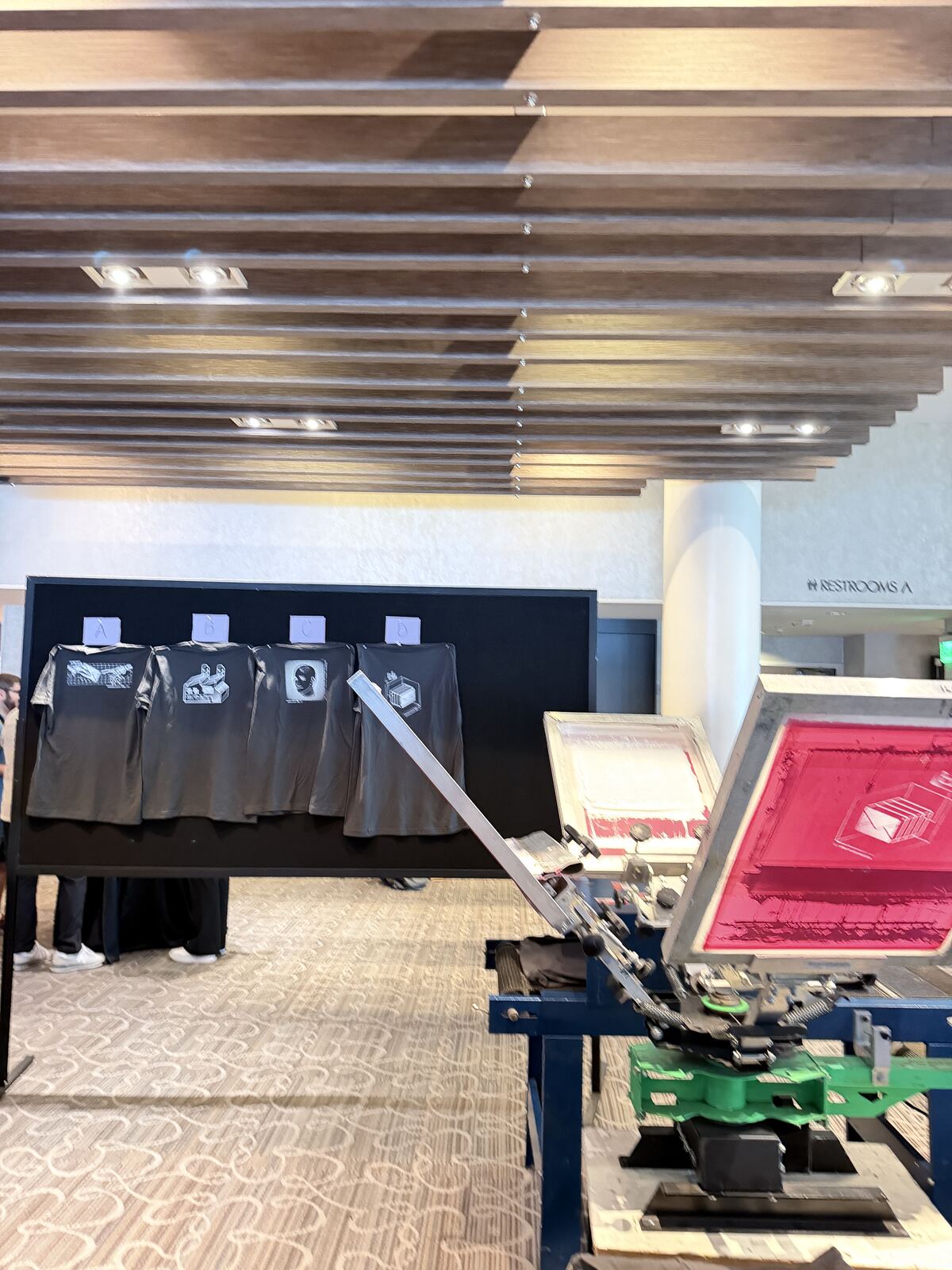
A live printing booth is a small factory that guests are allowed to stand inside. Get the layout right and the queue is the best-looking thing in the room. Get it wrong and you have a crowd of confused people asking a busy press operator where their shirt went.
Live printing booth queue design comes down to three decisions: which direction people travel, how many presses the arrival rate demands, and whether guests have to stand still while they wait. None of it is complicated, but all of it has to be settled before anyone draws a rendering.
Build it as a line, not a room
Four zones, always in the same order. Greet and choose is where a guest picks a garment, a size and a design. Stage is where that garment gets a claim ticket and joins the queue for the press. Print is the show. Pickup is a separate table with its own exit.
The single most common failure is a booth with one opening. Finished guests then walk back out through the people waiting to get in, which turns the entry into a scrum and makes the line look twice as long as it is. Give pickup its own edge of the footprint, ideally on the opposite side or at least a different face.
The press should be visible from the queue but never walked through. That visibility is the entire reason a live booth outperforms a table of folded merch — people queue because they can see the thing being made.
Do the arithmetic before you draw anything
Every layout question resolves once you know pieces per hour. Start with capacity:
- DTF and heat press: roughly 60 to 90 finished pieces per hour per station.
- Hat and patch bar: roughly 30 to 45 hats per hour per press.
- Live embroidery: 6 to 12 minutes per piece, so a handful per hour per head.
Then estimate demand. Take expected attendance, multiply by an honest attach rate, and divide by the hours you are open. A 600-person conference where the shirt is the signposted takeaway might see 70 percent participation: 420 pieces across four hours is 105 an hour, which is two stations. The same 600 people at a festival with six competing attractions might be half that, and one station copes.
The number to be afraid of is the gap. If demand runs 30 an hour above capacity, you finish the day with roughly 90 disappointed people and a line that never shortened. That is a staffing decision, not a queue-management one, and no amount of clever layout fixes it on the day.
Decouple choosing from waiting
The best queue is one nobody stands in. Once a guest has chosen, hand them a numbered claim ticket and tell them a time. They go and enjoy the event, you keep printing, and the visible line stays short — which, incidentally, makes the booth look more inviting to the next person walking past.
If you are already capturing contact details for the brand, a text-when-ready flow does the same job with less paper. Only do that where consent is genuinely being collected, not bolted on.
Where standing is unavoidable, make the wait productive. Put a size table upstream so guests handle garments and settle on a fit while queued, and hang finished samples where people can see them. A decision made in line is a decision that does not happen at the front of it.
Real dimensions, not rendering dimensions
Ten by ten fits one station and nothing else. Ten by twenty is where flow becomes comfortable, and twenty by twenty lets two stations run without operators colliding.
Allow around three feet of working depth behind each press. Presses face the crowd, but staff need a lane they can move along without stepping around a guest. Keep the intake table at the front edge with six to eight feet of frontage so two or three people can browse at once instead of forming a bottleneck at a single point.
Then plan the queue itself: figure about two and a half feet per person single file. Twenty people is fifty feet. Decide now whether that runs along your own frontage, folds back with stanchions, or spills into a fire lane and gets moved by the venue an hour in. Corner positions are worth asking for, because they give you two open faces and somewhere for a line to sit. Power is the last constraint — a dedicated 20-amp circuit per press, confirmed with the venue, not assumed. There is more on equipment choice in our guide to what to print.
Managing the rush you already know is coming
Almost every event has a predictable surge: doors opening, a keynote letting out, halftime, the end of a ceremony. Plan for it rather than reacting.
Use the quiet hour before to pre-stage. Sort popular sizes onto the intake table, pre-press blanks to remove moisture, and cue transfers for your most-requested designs. During the peak itself, cut the menu — three design options move a line close to twice as fast as nine, because choice is the slowest step in the process, not the press. Announce a last-ticket time early and hold it. Guests take a cutoff well when they hear it an hour out and badly when they hear it at the front of the line. Our booth planning guide and the station overview cover what each format needs.
Frequently asked questions
How much floor space does a live printing booth need?
Ten by ten is the practical minimum for a single station and it will feel tight all day. Ten by twenty gives you a real intake table, a working lane behind the press and a separate pickup point. Remember to plan the queue as well, since twenty people standing single file is about fifty feet of floor.
How long will guests actually wait?
That depends on the gap between arrivals and throughput, not on the press speed alone. One DTF station finishes roughly 60 to 90 pieces an hour, so if 120 people an hour want one, the line grows by 30 to 60 every hour and never recovers. Add a second station or hand out claim tickets so people wait somewhere more interesting.
What do we do when more people show up than we planned for?
Cut the design menu first, since fewer choices move a line faster than any other single change. Then announce a last-ticket time early and loudly so nobody queues for something they will not get. If the surge is predictable, such as a keynote letting out, pre-stage popular sizes during the quiet hour beforehand.
Send us your floor plan
Give us the footprint, the attendance and the run of show and we will mark up a layout with station count, queue direction and pickup placement before you commit to the space. Call (562) 614-4800 or get a quote.
Reserve your date
Put this into a real plan.
Tell us the date and venue and we'll spec the booth around it.
Prefer to talk it through? Call (562) 614-4800.